Overview of the Ford Bronco Raptor 2
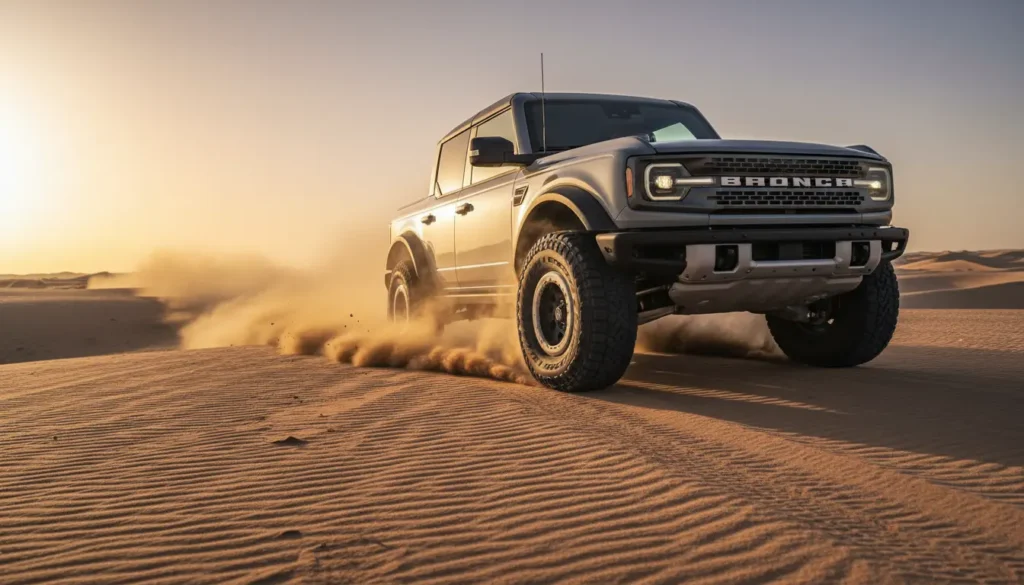
The Ford Bronco Raptor 2 is Ford’s purpose-built desert runner aimed at drivers who want extreme off-road capability straight from the factory. It combines a strengthened frame, long-travel suspension, and larger tires to handle high-speed runs over dunes and rough trails.
This article explains the key features, practical use cases, maintenance tips, and a short real-world example to help owners and prospective buyers understand what to expect.
Key mechanical features of Ford Bronco Raptor 2
The most visible upgrades on the Bronco Raptor 2 are the massive off-road tires and the Fox internal-bypass shocks tuned for desert running. These components extend wheel travel and improve stability over high-speed washboard terrain.
Other mechanical highlights include reinforced control arms, updated cooling systems, and tuned driveline components to handle higher stress during long high-speed runs.
Engine, powertrain, and cooling
Ford equips the Raptor 2 with a high-output turbocharged engine paired with a sturdy automatic transmission. The powertrain mapping focuses on mid-range torque for strong acceleration out of rough corners.
Upgraded cooling—larger radiators and additional oil coolers—helps maintain performance in hot desert conditions and during repeated hard runs.
Suspension and Fox shocks
Fox internal-bypass shocks are central to the Raptor 2’s capability. They provide controlled damping across small bumps and big impacts, with separate valving for the varied travel range.
Key suspension features include increased wheel travel, beefed-up springs, and reinforced mounting points to keep the suspension working reliably on extended desert runs.
Tires, ground clearance, and geometry
Massive tires improve traction and allow more ride height, but they also change gear ratios and steering feel. Ford calibrates the final drive and steering to compensate for larger diameter tires.
Ground clearance and approach/departure angles are improved compared to standard Broncos, which reduces the risk of underbody damage on technical desert sections.
What the tires and wheels mean in practice
- Better flotation over sand and soft surfaces
- Increased rotational inertia—slightly slower acceleration off the line but better momentum maintenance
- Higher unsprung weight—trade-offs in handling at lower speeds
Driver aids and modes for desert running
The Raptor 2 includes selectable drive modes that alter traction control, throttle mapping, transmission shift points, and electronic locking differentials. These modes make transitioning from rocky trails to open desert easy and predictable.
Features like trail control, hill descent control, and tuned stability systems allow drivers to focus on line choice while the vehicle manages torque and braking distribution.
Practical maintenance and owner tips
High-performance off-road vehicles need a disciplined maintenance routine. Check suspension mounts, shock reservoirs, cooling hoses, and wheel bearings more frequently than on a street vehicle.
Suggested maintenance checklist for desert use:
- Inspect Fox shocks and reservoir fittings after hard runs
- Check tire bead seating and pressures before and after each run
- Monitor transmission and differential fluid temperatures during long desert days
- Clean air filters more often—sand and dust reduce engine life and performance
Preparation checklist before a desert trip
- Lower tire pressure for better flotation on sand, and carry an air compressor for reinflation
- Secure spare parts: belts, hoses, and a spare wheel or repair kit
- Plan fuel stops and carry extra fuel if you expect long runs between services
Fox internal-bypass shocks use multiple valving zones to give different damping rates for small and large suspension movements. That allows a vehicle to be both compliant over washboard and controlled over big hits.
Cost, warranty, and real ownership considerations
Factory-built desert machines cost more than base models due to specialized components and testing. Buyers should account for higher consumable costs, such as tires and brake components, which wear faster in aggressive off-road use.
Check factory warranty terms for off-road components and consider extended coverage or a drift/dune use rider if you intend to run aggressively in extreme conditions.
Short real-world example
A regional off-road club in Arizona borrowed a Bronco Raptor 2 for a weekend desert loop to evaluate long-distance desert capability. The vehicle completed multiple high-speed stretches and technical canyons in a single day without failures.
The team noted markedly improved high-speed stability and shock control, but they also recorded increased fuel use and more frequent air filter and brake inspections than during normal trail runs.
Buying advice and who should consider the Bronco Raptor 2
The Bronco Raptor 2 is best for buyers who plan regular desert runs, high-speed off-road driving, or want a factory-built platform that requires less aftermarket modification for extreme use.
If your driving is mostly daily commuting with occasional trails, the Raptor 2 may be more capability—and cost—than you need. For serious desert racers and experienced off-roaders, it offers a ready-made, well-engineered package.
Summary: What to expect from the Ford Bronco Raptor 2
The Ford Bronco Raptor 2 blends massive tires, Fox shocks, reinforced structure, and desert-focused electronics to deliver a robust high-speed off-road package. It needs diligent maintenance and realistic expectations about operating costs.
For drivers who prioritize desert capability from the factory, the Raptor 2 is a ready-to-run option that minimizes the need for immediate aftermarket upgrades while delivering proven performance on dunes and open terrain.